
Introduction
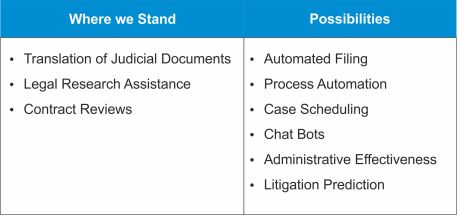
The Department of Justice is implementing the e-courts Mission Mode Project in close collaboration with the e-committee of the Supreme Court of India with the objective of universal computerization and ICT enablement of all District & Subordinate Court complexes. The Supreme Court of India has set up the Artificial Intelligence Committee to investigate the use of AI in the judicial sector. This committee has primarily identified applications of AI technology in the translation of judicial documents, legal research assistance, and process automation. However, AI technology has not been used in the second phase of the e-courts, which has been in development since 2015.
However, as per the draft Detailed Project Report (DPR), Artificial intelligence (AI) may be used for forecasting and prediction, increasing administrative effectiveness, automated filing, intelligent scheduling of cases, improving the case information system, and communicating with litigants through chatbots that may help with early case resolution.
Exploring the meaning: AI & ML
Section 5002(3) of the National Artificial Intelligence Initiative (NAII) Act 2020 defines the term “artificial intelligence” as a machine-based system that can, for a given set of human-defined objectives, make predictions, recommendations or decisions influencing real or virtual environments.
Additionally, section 5002(11) e of the NAII Act 2020 defines the term “machine learning” as an application of artificial intelligence that is characterized by providing systems the ability to automatically learn and improve on the basis of data or experience, without being explicitly programmed.
As stated by Chief Justice of India D.Y. Chandrachud, “technology is relevant insofar as it fosters efficiency, transparency, and objectivity in public government. AI is present to provide a facilitative tool to judges in order to recheck or evaluate the work, the process, and the judgments.” The primary purpose is to give common people greater access to justice in the long run.